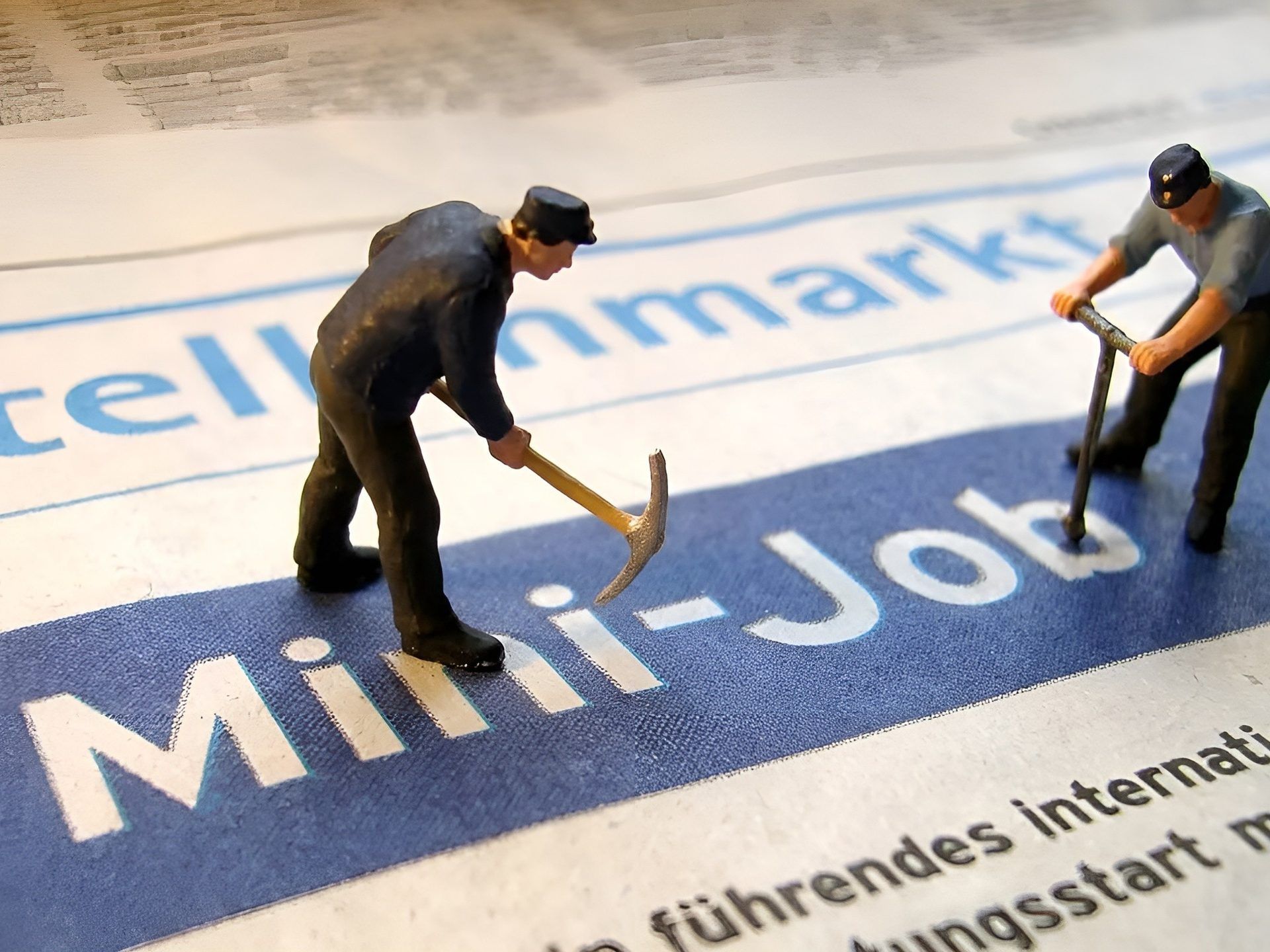
From 1 January 2026 Germany's statutory minimum wage is €13.90 gross an hour, up 8.42 percent from the €12.82 that applied through 2025. That single figure is the pay floor under more than six million workers, and several other thresholds are pinned to it. The rate is easy to look up. The part that catches employers is that Germany prices the minimum by the hour actually worked, not by the month, so a flat monthly wage that looks fine on the payslip can still fall below the floor once the hours behind that number are counted.
Here is the 2026 floor, why the hour is the unit that matters for payroll, and the mini-job ceiling that rises with the rate.
The 2026 rate, and why the hour is the unit that matters
From 1 January 2026 the statutory minimum wage (gesetzlicher Mindestlohn, set under the Mindestlohngesetz, MiLoG) is €13.90 gross per hour. That is an 8.42% rise from the €12.82 that applied through 2025, and the increase lifts the pay of more than six million workers. The Minimum Wage Commission (Mindestlohnkommission), a standing body of employer and union representatives, recommends the figure to the federal government, which enacts it by regulation; the 2026 step is the largest single raise the commission has recommended since the minimum wage began in 2015 (a larger one-time jump, to €12 in October 2022, came from the government outside the commission's process). The commission has already fixed the next step: €14.60 per hour from 1 January 2027.
The hourly basis is what makes German payroll different here. Germany sets a price per hour actually worked, not a daily rate as Mexico does, and not a monthly salary floor as Portugal does. A monthly floor is satisfied by one number on the payslip. An hourly floor is satisfied only if the hours behind that number are recorded and the division comes out at or above €13.90. A worker paid a flat €600 a month who logs 46 hours has been paid €13.04 an hour, below the floor, even though €600 looks generous next to the mini-job ceiling. The compliance question is never the monthly figure on its own; the answer is the monthly figure divided by the hours.
How raising the wage raises the mini-job ceiling automatically
A mini-job (geringfügige Beschäftigung) is marginal employment where the worker pays no social-insurance contributions and the employer pays a flat charge of roughly 30% to the Minijob-Zentrale. Since October 2022 the earnings ceiling has not been a fixed euro figure. The ceiling is calculated from the minimum wage: the minimum hourly rate multiplied by 130, divided by 3, rounded up. That formula stands for a notional 10 hours a week at the minimum wage.
For 2026 the arithmetic is €13.90 × 130 ÷ 3 = €602.33, rounded up to €603 per month (€7,236 a year). Earnings from €603.01 to €2,000 a month put the worker in a midijob, where employee contributions phase in on a sliding scale rather than starting at zero. When the minimum wage rose, the ceiling rose with it: the 2025 ceiling was €556, built on the €12.82 rate the same way.
The coupling both protects employers and creates a risk. On the protective side, a mini-jobber kept on the same hours stays a mini-jobber: the ceiling rises at the same pace as the wage, so the maximum billable hours hold steady at about 43 a month across the rate change. The risk is that the euro ceiling, not the hours, is the number people remember, and €603 looks like headroom. An employer who treats the higher ceiling as room to add shifts, rather than as the same 43 hours repriced, is the one who tips a worker over the line.
Worked example: the minimum wage by the hour, and the mini-job cap
Two round-number walk-throughs, both at the 2026 rate of €13.90.
A full-time worker on the minimum wage. Take a 40-hour week. Weekly pay is 40 × €13.90 = €556. Annualised and divided by twelve, 556 × 52 ÷ 12, the monthly gross is €2,409. That is the figure to compare against any monthly salary offered to a full-timer: below €2,409 for 40 hours a week, the contract is under the floor.
A mini-jobber near the ceiling. The 2026 ceiling is €603 a month. At €13.90 an hour, that buys €603 ÷ €13.90 = 43.4 hours a month, so 43 hours is the safe working month: 43 × €13.90 = €597.70, comfortably a mini-job. Add one more short shift and the month runs to 45 hours: 45 × €13.90 = €625.50. That total is above €603, so the worker is no longer a mini-jobber. Employee social-insurance contributions start on the midijob sliding scale, the employer's flat 30% charge no longer applies, and the reporting home for that worker changes. Two shifts, not a management decision, moved the worker between two contribution regimes.
The employer's two obligations: record the hours, and never pay below the minimum
The minimum wage puts two obligations on the employer. The first is that the minimum applies to every hour genuinely worked, which is why those hours have to be recorded. Employers must record the start, end, and duration of daily working time and keep the record for two years (Mindestlohngesetz §17; the Working Hours Act, Arbeitszeitgesetz, §16). For mini-jobbers and for the sectors named in the law against undeclared work (Schwarzarbeitsbekämpfungsgesetz), among them construction, hospitality, meat processing, transport, and building cleaning, the recording obligation is immediate rather than a month-end reconstruction. Enforcement runs through the customs authority's Financial Control of Undeclared Work unit (Finanzkontrolle Schwarzarbeit), which checks the records on site. Late or missing documentation is fined up to €30,000; paying under the minimum, up to €500,000, and a fine of €2,500 or more can bar a company from public contracts.
The second obligation is that the minimum cannot be signed away. An agreement to work for less than €13.90 an hour is void to the extent the pay falls short (Mindestlohngesetz §3); the worker keeps the claim to the difference regardless of what the contract says, and the passage of time does not extinguish that claim in the way an ordinary contractual claim might. A collective agreement (Tarifvertrag) or a sector regulation can set a higher floor, and several do, from construction to elderly care, but none can set a lower one. The minimum is a ceiling on how little a contract can promise, not a suggestion.
Both obligations reward the same discipline: keep the hours, and check the division every time a rate or a shift pattern changes. The rate changes on a published schedule, €13.90 now and €14.60 in January 2027, and the mini-job ceiling recalculates from each new rate on its own. Software that holds the current minimum, recalculates the mini-job and midijob thresholds when the rate changes, and flags a mini-jobber whose recorded hours are drifting toward the cap turns a January scramble into a setting. Flux keeps the rate and the derived thresholds current for each pay cycle, so the counter-staff case stays a warning rather than a back-payment. That leaves the operator watching the one thing arithmetic cannot watch for them: whether the hours on the timesheet are the hours actually worked.

Niko Nurmentaus
Product Lead
Related Posts